

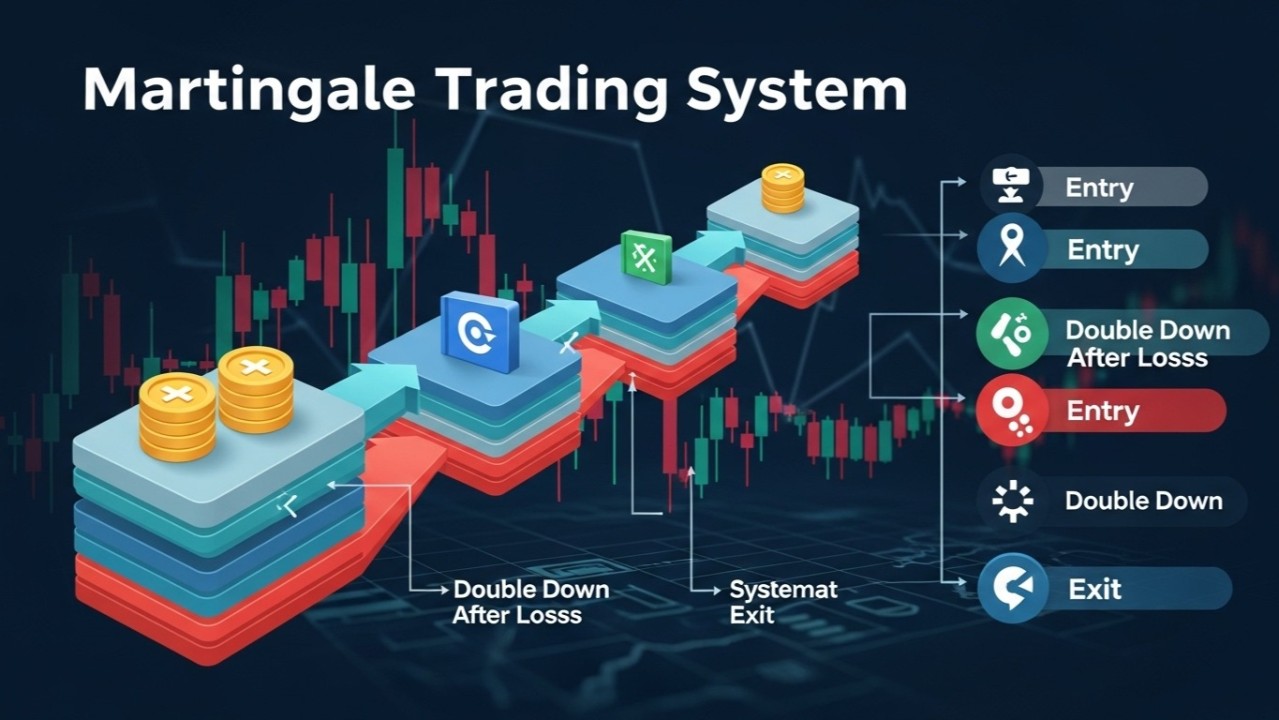
Martingale and grid systems are among the most popular automated trading approaches, especially in retail environments. They appeal to logic. Losses are recovered by increasing position size, averages improve as price retraces, and probability appears to favor eventual recovery. On paper, these systems look robust. In real markets, they expose one fundamental weakness: markets do not respect mathematical certainty.
At the core of martingale logic is the assumption that price will eventually return to a mean. Grid systems extend this assumption by distributing orders across price levels, allowing drawdown to be absorbed gradually until a retracement closes the structure in profit. This works repeatedly in stable, ranging conditions. That repeated success creates confidence. And that confidence is precisely where risk accumulates unnoticed.
Markets do not move in controlled distributions. They transition between regimes. Periods of range expansion, volatility compression, and directional imbalance occur unpredictably. When a martingale or grid system encounters sustained directional movement, the logic that previously worked becomes destructive. Exposure increases at the exact moment risk should be reduced. Drawdown accelerates not because the system is unlucky, but because it is structurally blind.
The most dangerous aspect of these systems is how slowly they fail. Profits accumulate steadily, reinforcing belief in the strategy. Traders begin increasing lot sizes, widening grids, or running multiple instances simultaneously. Risk feels manageable because losses are infrequent. But when failure arrives, it arrives asymmetrically. One trend, one volatility expansion, or one liquidity shock is enough to erase months or years of gains.
Grid and martingale systems also distort risk perception. Because losses are unrealized until collapse, traders underestimate exposure. Margin usage climbs quietly. Floating drawdown becomes normalized. The system appears calm until it suddenly isn’t. At that point, there are no good decisions left to make. Intervention only accelerates damage.
Another flaw lies in static assumptions. Most grid systems assume consistent volatility, stable spreads, and predictable execution. In live markets, these variables fluctuate constantly. Spreads widen during news, liquidity thins during session transitions, and slippage increases under stress. What looks manageable in backtests becomes lethal under real conditions. The system continues adding exposure as execution quality deteriorates.
The appeal of martingale and grid strategies is psychological as much as mathematical. They reduce the need to be right. Direction becomes irrelevant. This removes decision pressure, which feels comforting. But removing directional responsibility does not remove risk. It concentrates it. When responsibility is deferred to probability alone, structure disappears.
Professional execution avoids this trap by separating recovery from escalation. Instead of increasing exposure mechanically, risk is redistributed deliberately. Loss scenarios are planned, not averaged blindly. Exposure is controlled through structure, not hope. This is why professional frameworks reject pure martingale logic in favor of controlled, ratio-based models that can absorb adverse movement without exponential risk increase.
Execution frameworks such as the Trading HEDGE Strategy are built around this principle. They acknowledge that markets will move against positions, but they do not assume unlimited mean reversion. Exposure is balanced, not multiplied. Risk is defined, not deferred. This distinction is critical. It determines whether drawdown is survivable or terminal.
Martingale and grid systems do not fail because traders misunderstand them. They fail because markets eventually violate their core assumption. Probability works until structure breaks. When that happens, mathematics offers no protection.
The lesson is not that these systems are deceptive. It is that certainty in markets is an illusion. Any strategy that depends on inevitability rather than adaptability will eventually encounter a condition it cannot survive.
Martingale and grid systems do not lose often.
They lose completely.
